A TikTok money calculator estimates what an account could charge for one sponsored video, working from its followers, lifetime likes, video count and age. PlayerSells, an independent marketplace where established social media accounts are bought and sold through escrow, runs a free one that prices a post at $10 to $20 per 1,000 followers and then adjusts for engagement. The result is an estimate, not a verdict. Figures in this article were checked on 12 October 2026.
Free TikTok Views has a partnership with PlayerSells, the marketplace described here; the criteria we used to judge its tools are spelled out below.
What a TikTok money calculator actually works out
On the calculator's own account, most TikTok income comes from brand deals rather than the app itself, so a calculator is really a way of guessing what one of those deals might pay. We picked the PlayerSells TikTok money calculator because it prints its working. Our criteria were simple: it reads public data only, it asks for no password, it posts nothing to the account, it shows every rate it uses and it says what it cannot see.
The model has four moving parts, all listed on the page:
- A base rate of $10 to $20 per 1,000 followers for one sponsored post.
- An engagement multiplier between 0.6x and 1.6x, set by average likes per video against a 3.5% baseline.
- A posting cadence taken from the account's history, capped between 1 and 30 posts a month.
- An assumption that a quarter of those posts are paid.
The page works through one example. A creator with 5,738 followers, the median of its tracked catalogue, sitting exactly on the baseline is worth $57 to $115 for one sponsored post. With 300 videos over 24 months that is 12 posts a month, and the monthly estimate comes to $171 to $345. Change any input and the figure moves, so you can check the arithmetic by hand.
The calculator also lists what it cannot see: the Creator Rewards Program, LIVE gifts, TikTok Shop commission and affiliate income, none of which TikTok shows publicly. A shop-heavy creator will be understated, sometimes badly. And no model built on followers can price a niche, which moves brand rates further than anything else on the page. The rates are industry heuristics, not observed contracts, so treat the output as the start of a question: what has this account actually been paid?
Engagement rate: the check that does not depend on size
The TikTok engagement rate calculator divides total likes by video count, then divides that by followers. TikTok's public profile exposes only lifetime totals, so this is a lifetime average. It is harder to game than one recent post and slower to react: a creator who improved sharply this quarter reads low, and one carrying an old viral video reads high.
The rate is then graded against accounts of the same size, because one percentage means different things at different sizes.
| Account size | Below average | Average | Good | Excellent |
|---|---|---|---|---|
| Under 10K followers | 3% | 5% | 8% | 12% |
| 10K to 100K | 2% | 3.5% | 6% | 9% |
| 100K to 1M | 1.2% | 2.5% | 4.5% | 7% |
| 1M to 10M | 0.7% | 1.5% | 3% | 5% |
| 10M and above | 0.4% | 1% | 2% | 3.5% |
These are the calculator's own grading bands as printed on 12 October 2026, not a published TikTok statistic. Two limits matter. It is a likes-based rate, because comments, shares, saves and watch time are not on the public profile, so an audience that comments heavily but likes lightly will be understated. And it does not count fake followers. It only shows whether the audience reacts at the level typical for its size.
Follower rank: where the size sits
The TikTok follower rank places a follower count among the 22,481 creators in the PlayerSells catalogue, measured on 5 October 2026.
| Percentile | Followers |
|---|---|
| 25th | 577 |
| Median | 5,738 |
| 75th | 61,329 |
| 90th | 577,896 |
| 99th | 17,018,920 |
Read this with the caveat the page puts first. The catalogue was seeded from creators other creators reference, so it holds working creators rather than a cross-section of TikTok, and its median is nothing like the median TikTok account. A small account placing low has learned something about the sample, not about itself. The useful reading is upward, as milestones on the way to the size that gets referenced and booked.
Followers are not views
A follower count says little about what the next video will do. TikTok's own description of its recommendation system states that neither follower count nor previous high-performing videos are direct factors, and that accounts with more followers may get more views only because they have built a larger audience. How the feed weighs a video is covered in our guide to how the For You page works, and what the counter includes is in what counts as a view on TikTok.
For anyone sizing up an account, that means reading the view counts of recent videos on the public profile next to the follower count. A large number of followers with flat views tells a different story from the same number with views that keep pace.
What each tool measures, side by side
| Money calculator | Engagement rate | Follower rank | |
|---|---|---|---|
| Reads | Followers, likes, videos, account age | Likes, videos, followers | Follower count only |
| Answers | What a sponsored post might fetch | How active the audience is | Where the size sits |
| Compared with | A fixed table of rates | Accounts of the same size | 22,481 tracked creators |
| Cannot see | Shop, LIVE and affiliate income | Comments, shares, watch time | Anything about engagement |
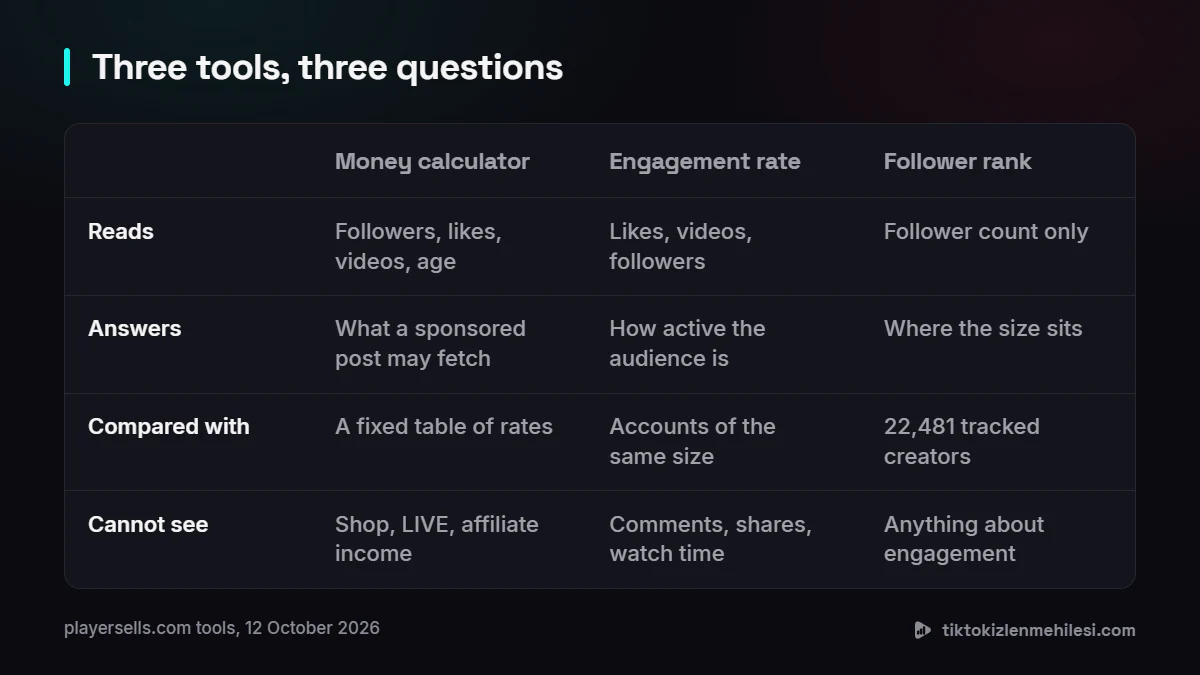
No single number settles anything. The money estimate depends on engagement, engagement depends on size, and rank depends on a sample. Used together they show whether the three numbers tell the same story.
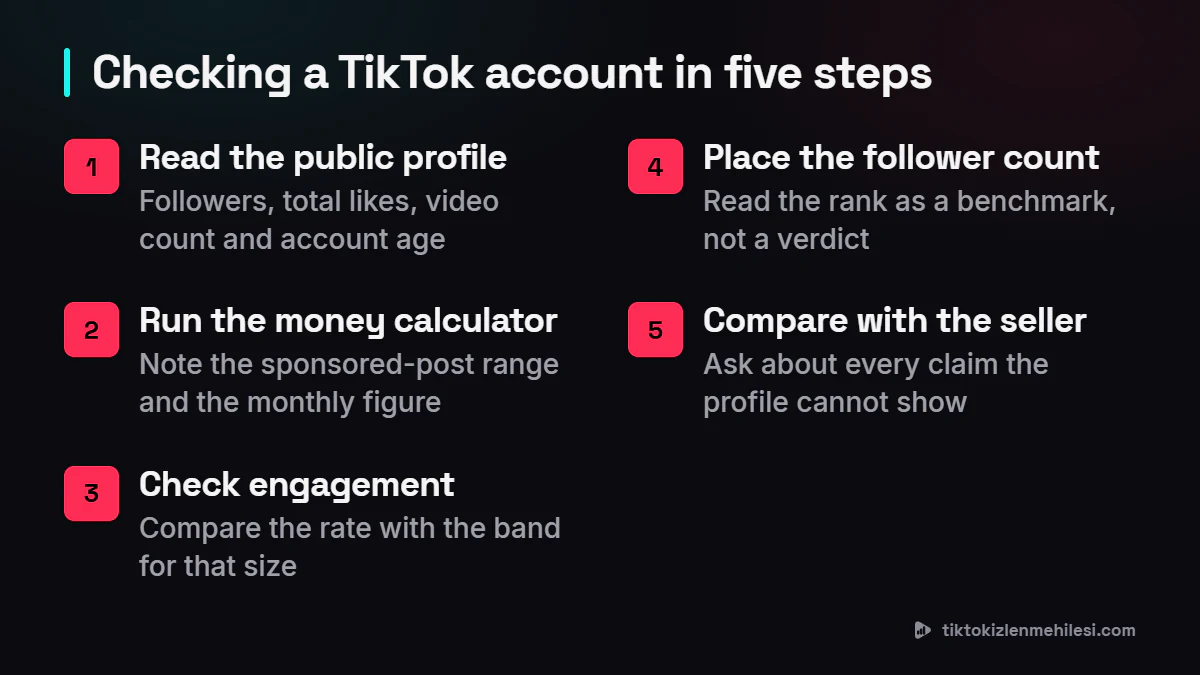
Checking an account in five steps
The same routine works for your own account or one a seller has listed, and it only needs what the public profile shows.
- Read the public profile: followers, total likes, video count and account age.
- Enter those numbers into the money calculator and note the sponsored-post range and the monthly figure.
- Run the engagement rate and compare it with the band for that size.
- Place the follower count on the rank table and read it as a benchmark.
- Compare all of it with what the seller says, and ask about every claim the profile cannot show.
If you are working on your own account instead, the same three numbers show where to put effort. Engagement is the one you can move: a free TikTok likes request or a free TikTok followers request is a small push, while the free TikTok views service and the other TikTok services cover the rest. None of them replaces posting regularly.
Where escrow fits when an account changes hands
PlayerSells is a marketplace, not a party to the sale and not the owner of the accounts. Its role is escrow and dispute handling. The buyer pays into escrow and the seller cannot touch the money. The seller then hands over the account, meaning the original email, login details, two-factor recovery codes and any connected access tokens, and the PlayerSells team verifies the handover. When the buyer confirms, the money goes to the seller minus the commission.
Before a listing goes live, the seller must prove control of the account, usually with a one-time code placed in the bio, and the listing is reviewed by hand. Listings that look bought, carry outside contact details or show numbers that do not match can be rejected. On its pricing page, as it read on 12 October 2026, PlayerSells lists a 15% escrow fee on account sales, with a minimum of $2.50 and a maximum of $750, free listings and a $1.50 withdrawal fee. The site says it has no hidden fees. The fee breakdown is shown before the buyer pays, and the current figures are always on the page itself.
Honest limits
- Platform rules. TikTok's terms of service tell you to keep your password confidential, make you solely responsible for activity under your account and let TikTok disable an account at any time. The account sections do not describe a way to transfer one. A bought account can be suspended, and escrow protects the payment, not the account.
- Estimates, not verdicts. The calculators produce estimates from public numbers and stated assumptions. The money figure is what a brand might pay a creator, not what a new owner will earn.
- Seller claims. Analytics, revenue and audience location are not on the public profile. Anything the platform cannot show is the seller's declaration, and the marketplace says so itself.
- A young marketplace. By the site's own count, PlayerSells has completed more than 205 transfers, handled over $22,500 in escrow and carries 560 listings, with a 4.9 out of 5 average seller rating. That makes it a fairly young and small marketplace, so weigh those figures accordingly.