How much TikTok views cost in 2026 comes down to a few cents: the median price is $0.075 per 1,000 views, checked on 4 November 2026 by PanelCompare, an independent site that compares SMM panel prices. The range PanelCompare says to quote runs from $0.0075 to $0.75 per 1,000, so even the dearest normal listing stays under one dollar. The real question is not the price but what you get for it.
This site has a partnership with PanelCompare, the source of the price data in this article.
How much do TikTok views cost per 1,000 in 2026?
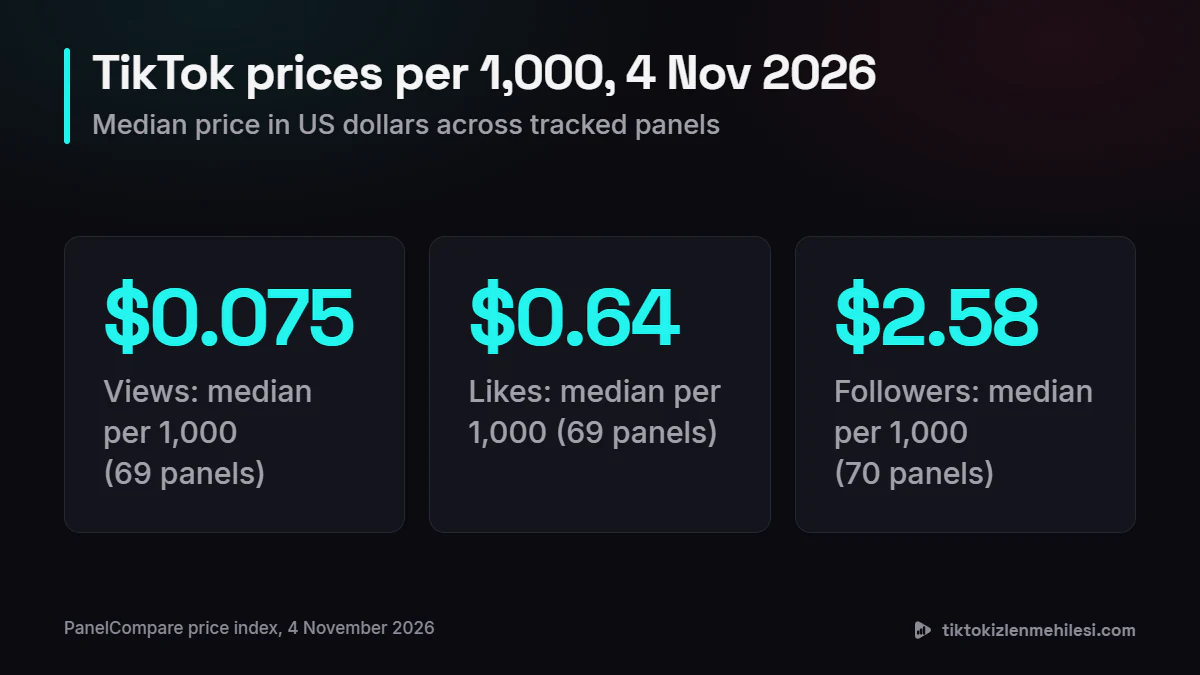
On 4 November 2026 the median TikTok views listing cost $0.075 per 1,000, based on 69 panels sampled by PanelCompare. The middle half of listings sat between $0.04 and $0.44, and the quotable range ran from $0.0075 to $0.75. You can see every listed rate behind that median on the live TikTok views price comparison page, which is where the numbers in this article come from.
A little context on the source. On that day PanelCompare tracked 152 panels (143 of them active), 43 platforms, 182 canonical services and 264,552 live offerings. Every price is per 1,000 units in US dollars, read from the panel's own API or its published price list, and dated. The "quotable range" is the cheapest and dearest listing within ten times the median, which is the span PanelCompare says to quote. Rows further out are usually a different product filed under the same name.
| TikTok service | Median per 1,000 | Middle half (p25 to p75) | Quotable range | Panels sampled |
|---|---|---|---|---|
| Views | $0.075 | $0.04 to $0.44 | $0.0075 to $0.75 | 69 |
| Likes | $0.64 | $0.38 to $1.05 | $0.069 to $6.40 | 69 |
| Followers | $2.58 | $1.70 to $4.52 | $0.26 to $25.80 | 70 |
Source: PanelCompare price index, 4 November 2026. All prices in US dollars per 1,000 units.
Why do TikTok view prices differ so much between panels?
Prices differ because panels selling "TikTok views" are often selling different products under one name. The rate is only one line of the offer, and the terms around it explain most of the gap.
Minimum order and deposit. A very low rate often comes with a minimum order or minimum deposit far larger than what you wanted. For views, the deposit minimum and the delivery terms usually matter more than the per-1,000 rate itself.
Start time and speed. Start time is the advertised lag before delivery begins, and it is an average rather than a promise. Speed is how many units arrive per day once delivery starts. A slow, cheap order and a fast, dearer one are not the same purchase.
Drip-feed. Drip-feed splits one order into batches delivered at fixed intervals, so your counter climbs gradually instead of jumping. On most order forms the quantity you type is per run, not the total, so the number of runs multiplies what you pay. People who read that field as a total end up ordering many times what they meant.
Refill. Some listings include a refill period, meaning the panel tops up views that drop off during a set time. Listings with refill usually cost more, and rows without refill can look cheap simply because nothing is promised after delivery.
How views are sourced. Views can be generated at huge scale for almost nothing, which is why they sit near the bottom of any price list. Delivery country, the kind of accounts or traffic used and whether a panel is reselling another panel's service all change the price. A view from a targeted country and a view from anywhere are priced as different things.
Why is the cheapest listing rarely the deal it looks like?
The cheapest listing usually saves you a fraction of a cent per 1,000 while hiding conditions that matter more. At the quotable low end of $0.0075 per 1,000 you are typically giving up refill, speed control or a known delivery country, and the saving against the $0.075 median is tiny in dollar terms.
Think about what you would actually spend. Because even the dearest quotable listing is $0.75 per 1,000, the rate is almost never what makes an order expensive. What costs money is a minimum deposit you will not use, a drip-feed order entered wrongly, or views that vanish with no refill. Listings below the quotable range are also the ones most likely to be a different product, a single package priced per order, or simply a typo.
A practical rule: start your comparison at the median and the middle half ($0.04 to $0.44), then read the terms. If a row sits far below that band, ask what is missing.
How do TikTok views compare with likes and followers on price?
Views are the cheapest TikTok service by a wide margin, likes cost more, and followers cost the most. On 4 November 2026 the median was $0.075 per 1,000 for views, $0.64 for likes and $2.58 for followers, according to the PanelCompare price index, which publishes these daily figures as open data under CC BY 4.0.
The gap follows the supply chain. A view needs a play on a video. A like needs an account that taps. A follower needs an account that stays attached to your profile, and followers are the most volatile thing to buy because they can drop off over time. The spread widens as you move up: the followers quotable range ran from $0.26 to $25.80, against $0.0075 to $0.75 for views. Judging a follower offer therefore needs even more attention to refill and drop rate than a views offer.
What can bought TikTok views not do?
Bought views raise a number; they do not bring watch time, a real audience or sales. A counter that jumps after a panel order is not people choosing to watch your video to the end, comment, share or follow, and those signals are what decide where a video goes next.
They also run against platform rules. TikTok's Community Guidelines on integrity and authenticity do not allow fake engagement, including buying or selling views, likes or followers, and TikTok can remove that engagement or restrict the accounts involved. Bought views can make a video look popular for a while. They cannot make the algorithm, or a viewer, actually care.
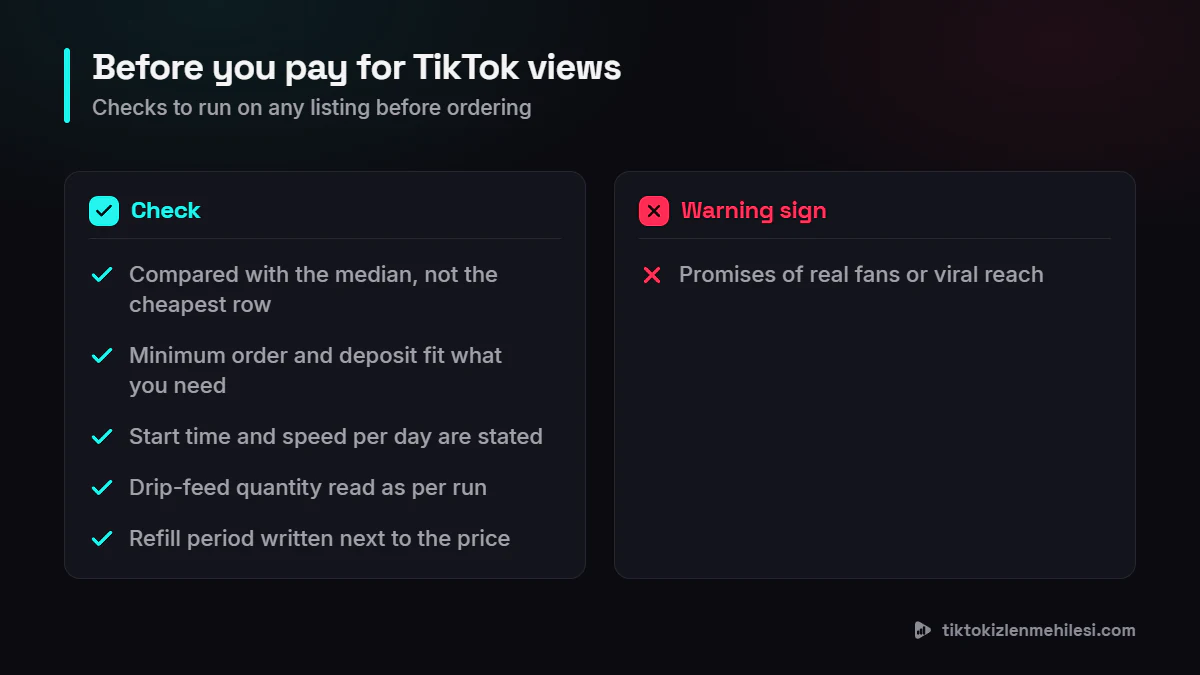
How to compare TikTok view offers: a practical checklist
Run these checks, in this order, before you pay for any TikTok views listing:
- Start from the median. Compare the offer against $0.075 per 1,000 and the middle half, not against the single cheapest row.
- Read the minimum order and minimum deposit. If you must load far more than you need, the low rate does not help you.
- Check start time and speed. Look for units per day and treat the start time as an average.
- Read the drip-feed fields slowly. Confirm whether the quantity is per run or the total before you submit.
- Look for a refill period. Note how long it lasts and whether it is written next to the price.
- Check delivery country and source. Worldwide and targeted views are different products.
- Test small. Place the smallest order allowed and watch how it behaves before going bigger.
- Ignore promises of reach. A listing that claims real fans or viral results is describing something views cannot do.
If you want to see how panels line up against the market on TikTok as a whole, PanelCompare keeps a list of TikTok SMM panels ranked by price against the market median. Treat it as a starting point for your own checks, not as a verdict.
What should you try for free first?
Try a small free test on this site before you pay anything. Send free TikTok views to one video and watch how your counter starts to tick: when it begins, how quickly it moves and whether the number still holds a day later. That shows you what a delivery feels like without spending a cent.
You can do the same with free TikTok likes and compare the two. The other TikTok tools on the site work the same way. Treat all of it as a small test, not a growth plan: free or paid, these numbers do not create an audience. The video itself does.
What are the limits of these prices?
These figures are a dated snapshot, not a quote. Panel prices change daily, so the rate you see tomorrow may differ from the 4 November 2026 numbers in this article, and a panel's own order page is the only place that shows what you would pay right now.
Platform rules apply whatever you pay. TikTok treats bought engagement as fake engagement, and a low price says nothing about whether views will stay or whether an account will be affected.
There is a legal side too. In the United States, the FTC rule at 16 CFR 465.8 makes it unlawful to buy or sell fake indicators of social media influence, such as views, likes or followers, when they are used to misrepresent influence for a commercial purpose. If you promote a business, a brand or paid content, that rule can apply to you.
Finally, no price tells you about quality on its own. Use the median as a reference point, read the terms, test small and keep your expectations tied to what views can actually do.